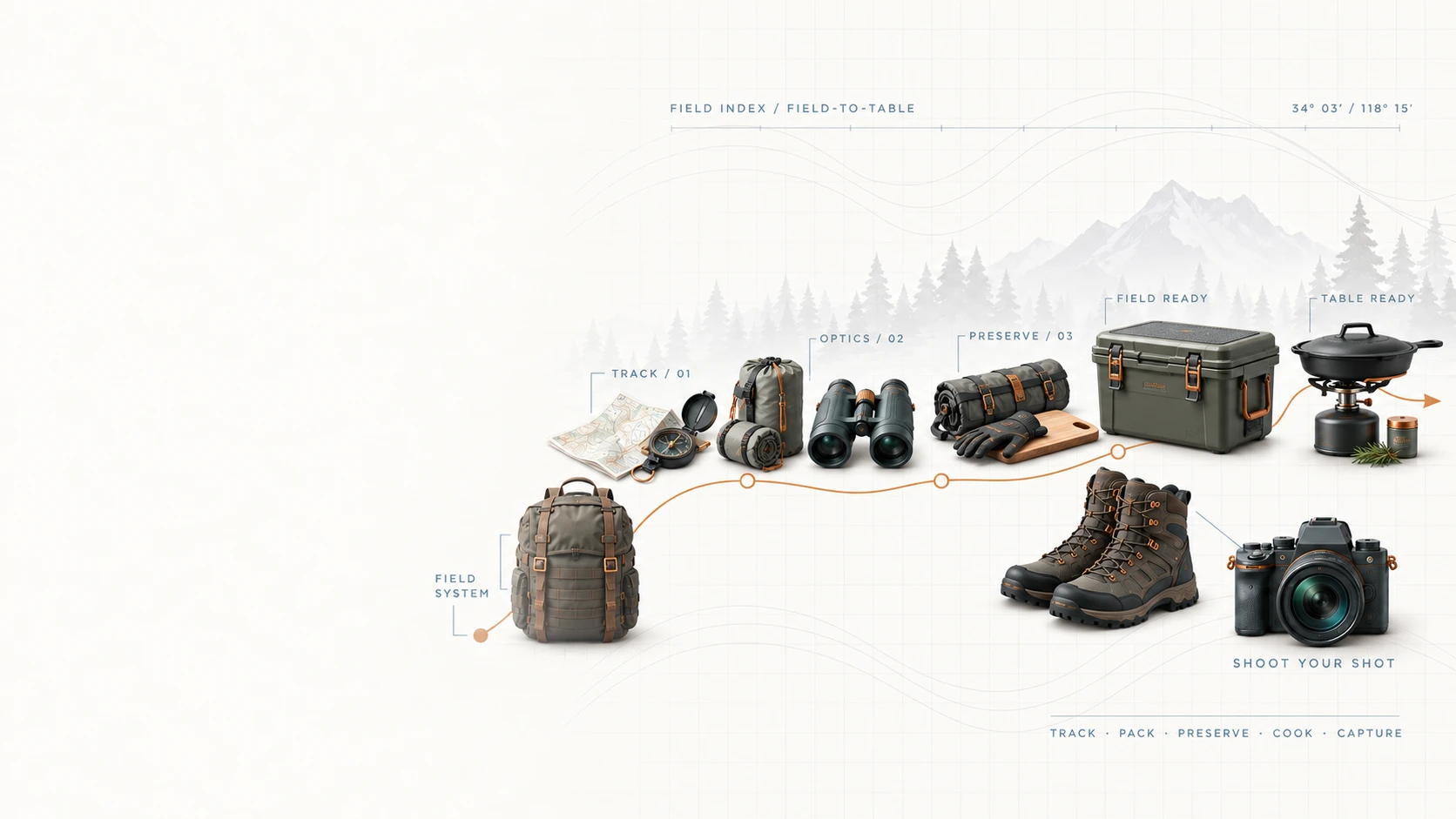
Method and region set the fit.
A whitetail hunter, a Western public-land elk hunter and a waterfowl hunter judge gear differently, even when a product page lumps them together as "hunting gear."

Hunting gear, matched with field-first creators
Your gear earns its place in the field and at the table. Connect with creators who put it through real hunts, and audiences who judge it by what came home.
Hunting & field-to-table specialistsUnited States + Canada
The short answer
Hunting influencer marketing connects non-weapon hunting gear brands with creators who hunt in the field and cook what they harvest.
Marketing Atom helps brands in the United States and Canada find relevant creators for product seeding and sponsored content, with campaign management and reporting. The focus is non-weapon gear: optics, packs, boots, apparel and field-to-table processing equipment. We do not work with firearms or ammunition brands.
01 / Know the audience
Why does hunting need a different approach? Because a harvest photo can start the conversation, but real field time is what earns trust.
A whitetail hunter, a Western public-land elk hunter and a waterfowl hunter judge gear differently, even when a product page lumps them together as "hunting gear."
Cold, wet, low light and multiple days without resupply are where hunting gear either holds up or doesn't. A driveway demo doesn't answer that.
Field-to-table cooks extend a product's story into processing and cooking, reaching viewers who follow the full process, not just the shot.
02 / Product context
Which hunting products do we work with? Select a category to see the product details, creator context and content angles a campaign can build around.
Optics
Binoculars, rangefinders and riflescopes are judged on glass quality and low-light performance, the conditions that actually matter in the field. A daytime bench comparison doesn't answer the real question.
Packs & boots
Packs and boots earn trust through multi-day, pack-out load carry and repeated wear, not a first-day fitting. Insulation, waterproofing and break-in only show up after real field time.
Apparel
Camo pattern, scent control and weather protection prove themselves across real field conditions, not a studio fitting. This audience tests apparel the way it tests everything else: in the field.
Field-to-table processing
Vacuum sealers, meat grinders and smokers turn a harvest into meals, giving a gear brand a second, natural moment beyond the hunt itself. Processing knives may be named as part of a gear list, but are never pictured, and no firearm, ammunition or kill imagery appears in any content we run.
These are illustrative campaign angles, not product claims or promised deliverables. The final brief depends on your gear and goals.
Tell us what you make ↗03 / Creator fit
Hunting audiences split by species, method and region. The right creator format depends on what someone needs to understand about your product.
| Creator perspective | What the content can show | A useful campaign starting point |
|---|---|---|
| Field-first huntersThe extended use | Gear used across changing field conditions over a full season, not one sit. | Show a product proving itself over repeated, real field use. |
| DIY public-land huntersThe unsponsored feel | Budget-conscious, gear-practical reviews that don't feel sponsored. | Give a practical product an honest, public-land field test. |
| Long-range shootersThe technical detail | Optics and precision-gear judged by a technically literate audience. | Give an optics product the technical detail a purchase decision needs. |
| Field-to-table cooksThe second moment | A product's story extended past the hunt, into processing and cooking. | Reach viewers who follow a hunter's full process, not just the shot. |
04 / Campaign possibilities
What can a hunting influencer campaign look like? Start with the question you want the content to answer, then build the brief around it.
Place your gear with relevant creators ahead of a real hunt. Product seeding opens the door to use and feedback; it does not guarantee a post.
Build paid content around a field test in cold, wet or low-light conditions, the ones that actually matter. Agree on the deliverables and give the creator room for an honest perspective.
Plan a field-to-table follow-up once a harvest is processed and cooked, extending a product's story past the hunt itself. No firearm, ammunition or kill imagery appears in any content we run.
Platform & format
There isn't one platform for every hunting product. Choose the format by how much explanation the gear needs and where a relevant creator already makes useful content.
Long-form space for gear that needs real field testing across a hunt.
Reels and carousels can make apparel, in-field results and field-to-table cooking easy to follow.
A focused demonstration can introduce a single useful feature without squeezing in the whole trip.
How it works
01 / The starting point
Share your product, customer and what you want the campaign to achieve.
02 / The right context
We focus on creators whose content and audiences belong with your gear.
03 / The campaign
Agree on the campaign scope, coordinate the content and report on the agreed measures.
Let's talk about your gear
Tell us what you make and what you're looking to achieve. We'll start with the product and the hunt it belongs in.
05 / Clear answers
Questions about hunting influencer marketing, creator fit and how the relationship works.
Have a different question? ↗No, not at launch. We work with non-weapon hunting gear: optics, packs, boots, apparel and field-to-table equipment.
No. Fit matters more than follower count. DIY public-land hunters with smaller, engaged audiences often suit technical gear better than large generalist channels.
Apparel and footwear are core categories alongside optics and packs, not an afterthought. Each needs a different kind of field proof, which is why creator fit is set at the archetype level, not the industry level.
Yes. Field-to-table content, game processing and cooking with vacuum sealers, grinders and smokers, is part of this industry. Processing knives may be named in copy but are never pictured, and we never show firearms, ammunition or kill shots.
Long-form YouTube for gear that needs real field testing, and Instagram for apparel, in-field results and field-to-table cooking content.
Brands hire and pay Marketing Atom for its brand-side services. Brands contract with and pay creators directly. Marketing Atom does not charge, pay or represent creators and is not their agent or manager.